

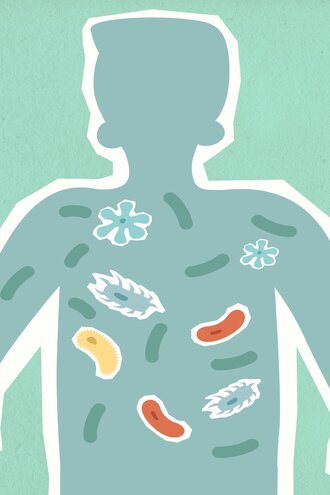
Have microbes changed what it means to be human?
Scientists around the world nowadays challenge the concept of a human as a “discrete self” and most include the trillions of organisms that collectively colonize the body. Some even say the human body isn’t that individual, as it is likely a meta-organism, whose complexity involves microbial interactions between the gut, brain, and trillions of microorganisms that mostly live in the intestinal tract.
The human’s entire microbiota is referred to as their microbiome. However, as much as ninety-five percent of the body’s microbiota resides in the colon where about 39 trillion microbial cells surprisingly outnumber the total number of cells in a human’s body. While bacteria make up the vast majority of these cells, other microorganisms are also present like fungi, archaea, and viruses, although viruses are acellular and do not perform basic life functions.
“Healthy gut bacteria produce metabolites like short-chain fatty acids, bile acids, and tryptophan derivatives,” explains Dr. Hans Wolf, the founder of WOLFPACC’s Physician Achievement Concept Course. “These molecules can enter the bloodstream, act on immune cells and tissues, and help regulate both inflammation and metabolism.” A diverse microbiome also maintains the integrity of the intestinal lining to prevent “leaky gut”, which allows toxins into systemic circulation, where immune dysfunction and chronic inflammation can thrive.
Hollow organs host microbial communities…
The concept of hollow-organ metabolic pathways involves the inter-organ metabolism and specific biochemical processes within organs of both the gastrointestinal and urinary tract. Unlike with Traditional Chinese Medicine that follows a theoretical framework for solid organs (Zang) and hollow organs (Fu), Western medicine identify specific hollow organs and focus on evidence-based anatomy, physiology and biochemistry when applying the science to inter-organ metabolism.
In alternative or complementary medicine like Traditional Chinese Medicine, meridians are pathways that are vital for energy flows. But, unlike a hollow organ with an internal lumen, meridians are non-physical, invisible pathways that are not described conventionally using the Krebs cycle. TCM meridians are linked to the body’s balance and harmony between the two forces that are essential for good health. Scientists are still studying the human body’s invisible pathways with recently discovered structural barriers like the interstitium.
The gastrointestinal tract is comprised of hollow organs and contain the highest microbial density of any community associated with the human body. This twisting tube that starts in the mouth and ends with the anus is the most populated habitat. While the entire digestive system does contain microbes, the population is densest in the small and large intestines that collectively host about 95% of the body’s microorganisms. But another organ, your gallbladder, releases bile acids that are essential for lipid digestion.
The hollow organs of the GI tract that are home to gut flora include your mouth, esophagus, stomach, small intestine, large intestine, and anus. In contrast, your liver, pancreas, and gallbladder are the solid organs of your digestive system. Nonetheless, it is primarily gut bacteria in the colon that are most essential for digestion. Plus, gut-dwelling microbes play an integral role in orchestrating the assimilation of nutrients and production of metabolites that impact immune function and metabolic wellbeing.
Resetting of Microbial Pathways
What a person eats plays a huge role in their gut health. A diet packed with fiber, fruits, and vegetables gives good bacteria the nutrients they need to flourish. On the flip side, it’s just as important to cut back on highly processed foods, sugar, and artificial sweeteners that feed the less desirable microbes. To give good bacteria a boost, focus on prebiotics and probiotics. Prebiotics are special types of fiber that feed healthy microbes, and probiotics that are found in fermented foods can help repopulate the gut with live beneficial bacteria.
“When you talk about resetting microbial pathways in the gut,”, adds Dr. Wolf, “you are really talking about restoring a healthy balance of diverse bacteria. This can most often be achieved through a combination of changes to dietary intake and lifestyle habits, as well as proper supplementation when needed.” For example, glutamine is most often naturally produced in adequate quantities, but after injury or illness, you might need L-glutamine supplementation to restore innate immunity.
Restoring microbial balance isn’t just about what someone eats. Managing stress, getting enough quality sleep, and drinking plenty of water are also crucial. These habits support overall digestive health and keep things moving (gut motility) as they should throughout the digestive system. In cases of severe imbalance or specific infections, it’s best to consult with a professional as they may need to prescribe targeted treatments to clear up infections. It’s also important to manage health issues, such as diabetes, as it too can affect microbial balance.
Since the gut microbiome directly influences metabolic health in humans, a systemic resetting of the gut’s microbial pathways should focus on therapeutic strategies aimed at restoring balance (eubiosis) to the gut’s ecosystem. Instead of just quick fixes for surface-level issues, this reestablishes a harmonious and stable relationship among the gut flora, which is crucial for improving an individual’s health. Interventions must also be designed to produce beneficial metabolites that strengthen the lining of the gut barrier.
Is the Microbiome an Organ or Slave Tissue?
Since the turn of the century, the microbiome has been under scientific investigation as potentially one of the last human organs being studied. Even today, some experts refer to it as an organ simply because it performs such a wide range of essential functions that are deeply integrated with bodily systems. This includes aiding in digestion of food intake, regulating metabolism, producing vital nutrients, and training the immune system from birth through aging. Certainly this complex community of microbes can be viewed as a virtual or “meta” organ.
It is human sperm and egg that form the innate genome and various microbes that become the adaptive genome that allows the brain to communicate with your immune system via chemical messengers and neural networks from birth. This axis along with the central and peripheral nervous systems work together to coordinate your ever-evolving innate and adaptive immunity, as well as mucosal and system immunity. From a macroscopic perspective, however, during human evolution various models have been developed to regulate the commensal relationship with adaptive genomic profiles including:
a) Adaptation to variations in diet – What you eat directly shapes the community of trillions of microorganisms living in your gut. These tiny residents play a huge role in your overall health, and they react quickly to the foods you consume. For example, dietary protein can boost the variety or diversity of your gut microbes. On the other hand, a high-fat diet can lower the levels of beneficial bacteria like Lactobacilli while increasing others that produce important short-chain fatty acids. By making targeted changes to one’s diet, you can influence their gut microbiota, which offers a powerful way to optimize their metabolism and improve overall health.
b) Adaptation to environmental conditions – It’s not just genetics that shape your microbial communities; your environment plays an even bigger role. You can see this in how H. pylori bacteria have evolved differently across the globe due to human migration. European populations, for instance, show high genetic diversity from centuries of movement, leading to distinct gut, oral, and urinary microbiomes compared to other parts of the world. Even more extreme environments, like outer space, can have a profound impact on our microbes. During spaceflight, microgravity and radiation alter the composition and genetics proving how quickly microbiomes can adapt.
c) Adaptation to various medications – When someone takes an antibiotic for chronic infection like tuberculosis, it can initially disrupt the gut’s balance and allow drug-resistant germs to take over. But here’s the cool part: the good bacteria in the gut often fight back and adapt, eventually outnumbering the bad ones. But, it’s not just antibiotics. Other medications like antidepressants can also cause bacteria to develop resistance more quickly. On the flip side, these trillions of tiny microorganisms in the gut can actually help a person’s body respond better to treatments like cancer immunotherapy.
d) Adaptation to established microbial communities – The human gut is home to a bustling community of microbes that’s like a neighborhood where some residents help each other out, while some ignore each other, and others are in constant competition with each other. Research shows that over half of these microbial relationships are neutral where microbes simply coexist without affect. About a fourth are involved in helpful relationships while slightly less than twenty percent of the gut microbes are trying to push the others out. Understanding how these microbes get along is key to keeping the gut ecosystems stable and healthy.
Your microbiome is made up of trillions of non-human microorganisms that are so closely connected to your body that some consider them to be a single biological unit. This concept, known as the holobiont, views you and your microbiome as one entity, which collectively weighs about the same as the brain or heart. While not exactly a separate organ, your gut microbiome is a key part of your body. It constantly communicates with you and even acts as additional slave tissues, working alongside your nervous, epithelial, connective, and muscular tissues to keep you healthy.
Photo credit Monstera Production
________________________
Attempts to classify microbial tissues with greater precision has the science entering into new territory. But, with the daunting challenges today’s medical students face in various health crises like obesity, diabetes and antimicrobial resistance, more research is needed to determine if what lies beneath the surface is just the tip of this microbial iceberg and microbes have changed what it means to be human. Dr. Hans Wolf devoted decades to developing WOLFPACC’s Power 5 Methodology that helps medical students understand how to apply the basic sciences they learned in medical school to the clinical task at hand. Find out today how WOLFPACC can help you apply the knowledge you’ve gained to ensure a successful career in medicine.